
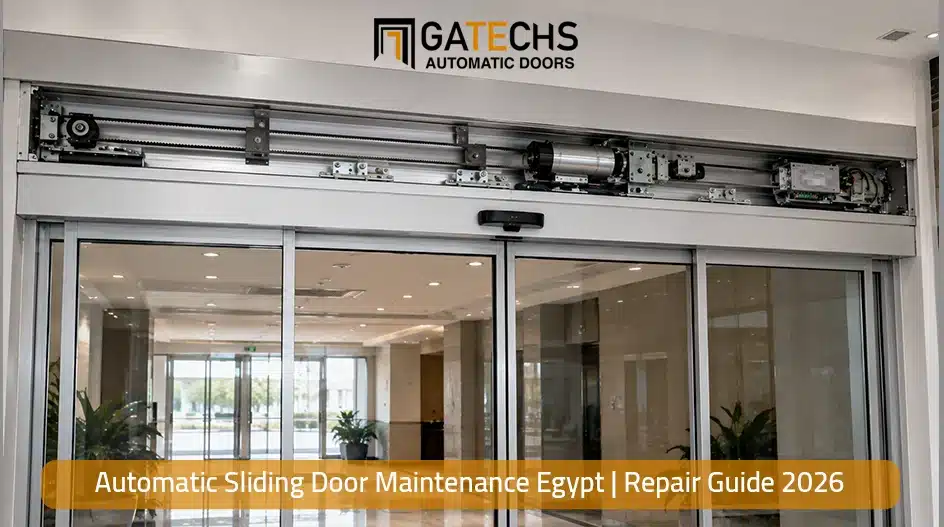
Commercial automatic sliding doors in Egypt operate under demanding conditions, including high traffic, dust, heat, and humidity. Regular automatic sliding door maintenance helps keep tracks, rollers, sensors, and drive systems operating safely and reliably while reducing unexpected downtime.
At Gatechs, we offer expert checkups, repairs, and full technical support for automatic sliding door operating systems in Egypt. We proudly serve malls, hospitals, office towers, and commercial facilities across the country.
Automatic Sliding Door Preventive Maintenance Schedule
Use this consolidated schedule to manage in-house facility checks alongside scheduled professional engineering visits:
| Frequency | Key Components | Required Maintenance Action | Responsible Team |
|---|---|---|---|
| Daily | Threshold & Floor Guides | Sweep and vacuum bottom channels to remove stones, sand, and dust. | Facility Housekeeping |
| Weekly | Activation & Safety Sensors | Gently wipe sensor optical covers with a dry micro-fiber cloth. Test walk-in response. | Facility Housekeeping |
| Monthly | Safety Curtains & Manual Mode | Place an obstacle in threshold to verify safety stop. Test manual sliding resistance. | Facility Engineer |
| Quarterly | Backup Battery & Track Area | Simulate mains power outage to test battery open/close mode. Vacuum top header track. | Facility Engineer |
| Semi-Annual | Full Drive & Mechanical System | Calibrate belt tension, check roller wear, test safety forces, and check event logs. | Gatechs Technical Team |
Troubleshooting Common Automatic Sliding Door Faults
When an entrance malfunctions, use this diagnostic matrix to identify the root cause and determine the appropriate corrective action:
| Observed Symptom | Probable Root Cause | Immediate In-House Action | Professional Service (Gatechs Scope) |
|---|---|---|---|
| Door does not open | Power cut, key switch set to locked mode, or disconnected sensor | Verify main electrical switch and mode selector settings | Diagnose controller voltage, test motor windings, or replace sensor module |
| Door will not close | Obstructed safety curtain, dirty sensor lens, or hold-open mode selected | Wipe sensor covers and clear objects from threshold path | Recalibrate sensor detection zones or replace defective receiver |
| Door opens and immediately reverses | Dirt in floor guide, high mechanical friction, or obstacle sensor active | Clean bottom guide channels and remove foreign objects | Adjust controller obstacle sensitivity and relevel carriage rollers |
| Slow or jerky leaf movement | Worn roller bearings, loose timing belt, or low-speed safety mode | Check track surfaces for visible dirt or obstructions | Replace flat-spotted rollers, retension drive belt, or reset controller |
| Ghosting (opens without traffic) | Radar detecting moving plants, drafts, reflections, or insects | Remove moving banners or plants near doorway | Adjust radar angle and configure cross-traffic rejection filters |
| Grinding or scraping noise | Worn roller treads, dry bearings, or door leaf dragging on floor | Check bottom aluminum profile clearance over floor tiles | Re-align vertical suspension bolts and replace worn carriage assemblies |
| Fails during power cuts | Depleted or disconnected 24V emergency backup battery | Check battery wiring harness on control board | Perform load testing and install compatible replacement batteries |
Automatic Sliding Door Cleaning & Housekeeping Best Practices
- Sensor Optical Lenses: Clean lenses exclusively with a dry micro-fiber cloth. Avoid alcohol-based solvents or glass cleaners that could cloud the plastic cover.
- Header Track & Carriage Area: Vacuum internal aluminum profiles to remove dust, sand, and lint. Wipe surfaces with a dry or lightly damp cloth.
- Floor Guides & Thresholds: Keep bottom guide paths clear of dirt, stones, and water.
- Important Safety Warning: Never spray water directly into the header chassis or control box. Liquid ingress will destroy electronic controllers, motors, and wiring terminations.
Does an Automatic Sliding Door Track Need Lubrication?
For most modern systems, the answer is no. Most automatic sliding doors use synthetic nylon or plastic wheels that run on dry aluminum tracks.
Do not apply grease or heavy oil to the track. Oil attracts dust and sand, creating a sticky paste that grinds down the wheels and damages the track. If the manufacturer recommends lubrication, use only an approved dry silicone spray on specific pivot points. Never lubricate the drive belt.
How Egypt’s Climate Affects Automatic Sliding Door Maintenance
Operating entrance automation in Egypt involves distinct regional challenges:
- Dust and Sand Exposure: In arid areas and desert expansions, fine dust enters header tracks and bottom guides. Exposed entrances require more frequent track vacuuming and optical sensor wiping.
- High Summer Ambient Heat: Elevated temperatures increase thermal stress on drive units. Selecting operators with efficient heat dissipation and ensuring unblocked enclosure ventilation helps prevent thermal cut-outs.
- Coastal Salinity & Humidity: Coastal installations in Alexandria and New Alamein face accelerated corrosion. Utilizing corrosion-resistant fasteners, anodized aluminum profiles, and sealed sensor housings maintains system durability.
- Power Interruptions & Voltage Spikes:Sites affected by voltage fluctuations or frequent power interruptions should use appropriate surge protection and maintain the backup battery according to the operator manufacturer’s requirements.
When to Repair vs. Replace vs. Modernize
- Repair the System When: Problems are limited to wear-and-tear parts like wheels, belts, floor guides, or sensors, while the motor and controller still work well.
- Replace Specific Components When: Single parts reach the end of their life, such as installing a fresh backup battery or updating an old sensor.
- Modernize the Operator When: The existing controller is obsolete, replacement parts are unavailable, maintenance costs escalate, or safety compliance needs updating. Modern retrofits replace only the operator drive pack without structural glass remodeling.
Automatic Sliding Door Maintenance, Repair & Lifecycle Planning
Proper maintenance protects your long-term capital investment. For complete project context, consult our related engineering resources:
- To review different entrance configurations, explore our guide to automatic sliding door types and specifications.
- To evaluate European drive technologies, read our review of top automatic sliding door suppliers in Egypt.
- To compare installation budgets and equipment pricing tiers, see our guide to automatic sliding door prices in Egypt.
Gatechs Entrance Maintenance & Technical Support
Gatechs provides professional preventive maintenance programs, diagnostic troubleshooting, and technical support across Egypt For Automatic Doors:
- 15+ Years Field Experience: Engineering expertise across commercial, healthcare, governmental, and industrial entrance automation.
- Experienced Technical Team: Engineers and technicians equipped for on-site diagnostic testing, sensor calibration, and mechanical alignment.
- Quality Replacement Components: Access to manufacturer-compatible parts and assemblies to keep your entrances operational.
- Nationwide Service Coverage: Rapid site service across Cairo, Alexandria, 10th of Ramadan City, and the New Administrative Capital.
FAQ About Automatic Sliding Door Maintenance
How often should commercial automatic sliding doors be serviced?
Maintenance intervals depend on the manufacturer’s recommendations, traffic volume, environmental conditions, and site requirements. Many commercial facilities use 6–12 month professional service intervals, while high-traffic entrances may require more frequent inspections.
Why is my automatic sliding door moving slowly?
Doors move slowly when dirt blocks the track, the wheels are worn out, or the system shifts into a slow safety mode after hitting an obstacle.
Why does my automatic sliding door open but fail to close?
This usually happens if a sensor sees an object in the doorway, the sensor cover is dirty, or the switch is set to keep the door open.
Why does an automatic sliding door keep reversing?
A door reverses if a safety sensor spots someone in the doorway. It can also reverse if the motor hits resistance from dirt in the floor track or stuck wheels.
How do I clean automatic door sensors safely?
Wipe the outer plastic sensor cover gently using a dry or slightly damp micro-fiber cloth. Never use abrasive chemicals, solvents, or high-pressure water.
Do automatic sliding doors need track lubrication?
Most modern sliding doors use synthetic rollers designed to operate on dry tracks. Applying grease to tracks is generally discouraged unless specifically required by the manufacturer, as it attracts dust and grit.
How long can an automatic sliding door operator last?
The service life varies by operator quality, operating cycles, installation conditions, maintenance, and environmental exposure. Regular preventive maintenance helps identify component wear before it leads to major system failure.
Can automatic sliding doors work during a power cut?
Yes. Doors with a backup battery can keep working or open automatically to let people exit safely during a power outage.